Salesforce Fin Alternatives: How to Choose the Right Conversational AI Platform in 2026
Salesforce now owns Fin. Compare Fin, Agentforce, SalesAPE and Structurely to find the right conversational AI for support, automation or sales.
September 23, 2026
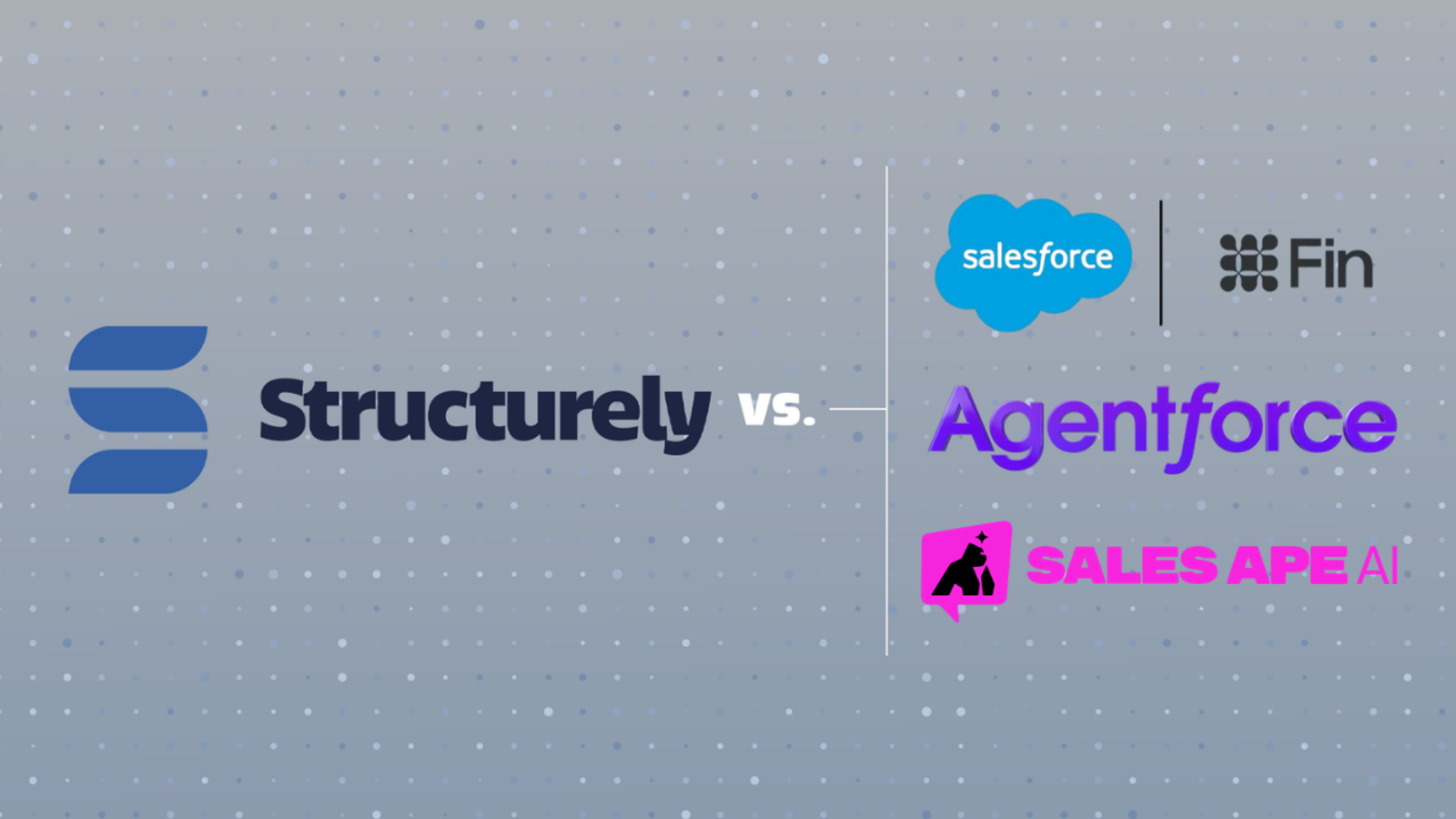
Fin (formerly Intercom) is a finished customer support agent that answers inbound questions and resolves tickets on its own, now owned by Salesforce.
Agentforce (Salesforce) is a platform for building custom AI agents for support, sales and internal tasks on your Salesforce data.
SalesAPE is an AI sales agent that replies to inbound leads and books meetings.
Structurely is an AI-powered outreach platform. It runs calling, SMS, qualification, live transfer, CRM enrollment and reporting as one coordinated workflow. Run it as a finished product or build your own conversational AI on the same platform.
On Salesforce: Structurely connects through a native managed package, so outreach runs against the Salesforce records your team already uses.
In September 2026, Salesforce completed its acquisition of Fin, the company formerly known as Intercom. Fin answers customer support questions and resolves tickets across chat, email, messaging and voice. The deal recently put conversational AI back in the headlines.
Conversational AI is one label for tools that can do a variety of different tasks. Some tools can handle customer support, others allow companies to build custom agents for a range of tasks, and some run sales outreach and follow up with leads. They are not interchangeable, so the first step is deciding what you need the tool to do, not which brand to buy.
Structurely is an AI-powered outreach platform specifically built for sales workflows. It calls, texts and qualifies leads, follows up through missed calls and callbacks, then hands a ready lead to a rep. A team can run it as a finished product or build on it through its APIs.
What did Salesforce's acquisition of Fin change for customers?
It gave Salesforce a stronger customer support agent. It did not add anything for sales or lead follow-up.
Fin is a customer support agent. It answers inbound questions on its own, using a company's help content and past tickets, and Salesforce says it resolves an average of 76 percent without a person. Inside Salesforce, Fin reinforces the service side of the Agentforce platform.
For a company already using Fin, the deal raises fair questions about the roadmap ahead and how per-resolution pricing adds up as volume grows. Before comparing products, though, it is important to decide what you need the AI to do. Fin handles customer support. If your need is calling, texting and following up with sales leads, that is a different task, and it points to a different kind of tool.
The three main uses of conversational AI
Most tools are built to do one of three things.
The first is customer support. A finished agent like Fin answers inbound questions and resolves tickets on its own, and is measured by how many it handles without a person. It responds when a customer reaches out.
The second is custom automation. A platform like Agentforce lets a company build its own AI agents for a range of tasks, from support to sales to internal requests, using its Salesforce data. It is broad and configurable, and it works best for teams that build inside Salesforce.
The third is sales outreach and lead follow-up. This is Structurely's focus. It calls and texts leads, asks the qualifying questions a rep would ask, follows up through missed calls and callbacks, then hands a ready lead to a person. It can run as a finished product, or a team can build its own on the same platform.
A customer support agent and a sales agent are not the same thing. One answers customers who reach out. The other reaches out to leads and works to convert them. Choosing the wrong one for the task is a common mistake.
| Feature / Capability | Fin | Agentforce | SalesAPE | Structurely |
|---|---|---|---|---|
| Built for | Customer support | Custom AI agents on Salesforce | Replying to inbound sales | Sales outreach and lead follow-up |
| Inbound/Outbound | Inbound | Either, by configuration | Inbound | Outbound and inbound |
| How to deploy | Finished agent | Built on Salesforce platform | Finished agent | Finished product or build on the platform |
| Channels | Chat, email, messaging, voice | Salesforce- supported channels | Chat and text | Voice, SMS and email with shared context |
| Live transfer to a rep | Escalates to support | Via configured handoff | Books meetings | Built in, with context attached |
| Salesforce fit | Owned by salesforce | Native to Salesforce | Integration capabilities | Native managed package |
| Result | Resolved support tickets | A custom agent for your Salesforce processes | Booked meetings from inbound | Qualified leads passed to reps |
Fin vs Agentforce vs Structurely: what each is built for
Each is strong at what it was built for. The choice comes down to which one matches what your business needs.
Fin is excellent at customer support. If your queue is full of customers asking "where is my order" and "how do I cancel," a finished agent that answers those on its own, now inside Salesforce, is a strong fit. It is not built to call a lead, qualify a buyer or move a deal forward.
Agentforce is powerful and flexible. Teams that already run on Salesforce can use it to build custom agents on their own data. That takes real setup, and it works best inside the Salesforce ecosystem rather than across a mix of outside systems and channels.
SalesAPE is a focused AI sales agent that replies to inbound leads and books meetings. For a team whose main gap is answering and booking new inbound quickly, it does that job well.
Structurely runs the full sales outreach workflow as one connected system. It calls from the same number it has already texted from, asks the qualifying questions a rep would ask, follows up through missed calls and callbacks, hands a ready lead to a person and writes qualification and outcome data back to the connected CRM. It runs voice, SMS and email on one platform, and a team can also build the full workflow on its APIs.
What to look for in a conversational AI platform for sales
These are the capabilities that matter most for calling, qualifying and following up with leads.
- Shared context across channels. Calls, texts and email should share context for a single lead, not sit in separate tools that do not share information.
- Proactive outreach. The system should reach out and follow up on its own, with logic for missed calls and callbacks, rather than only respond when contacted.
- Real qualification and a live handoff. It should ask the questions a closer needs. answered, then transfer a ready lead to a person with the context attached.
- CRM writeback and reporting. Every conversation and result should land in the CRM, with contact, qualification and handoff numbers a manager can see.
- The option to build your own. The strongest platforms let you run the finished product or build your own agent on their APIs and workflows, so the setup fits your business instead of a fixed template.
- Configurable compliance controls. Consent, suppression, calling hours and recording should be settings the operator controls, since compliance is a shared responsibility.
- Expertise on hand. If there is no in-house AI team, a platform whose engineers and trainers help build it removes the need to hire for that first.
Structurely covers that list. It runs calling, SMS, qualification, live transfer, CRM enrollment and reporting in one workflow, follows up proactively and can run as a finished product or be built on through its APIs. When there is no in-house AI team, its engineers and trainers build alongside you. For teams that want to build their own, building your own conversational AI application covers each point in depth.
Is Fin a fit if the goal is converting leads?
If your need is sales outreach and follow-up, Fin is built for a different task.
Fin is built for customer support, and it does that well. It is not made to call and text a new lead, qualify them and pass a ready buyer to a rep. That is a different task with different requirements. If your weak point is speed to lead, follow-up or qualification, the answer is a tool built for outreach, not a support agent asked to do it.
What are the best alternatives to Fin?
The right one depends on what you need the AI to do.
Choose a finished support agent, like Salesforce's own Agentforce, if you need to handle customer support.
Choose a build-your-own platform with an open API, webhooks and workflows if you want to build and run your own agents.
Choose SalesAPE if you want a focused AI sales agent for lighter inbound work.
Choose Structurely if you want calling, texting, qualification, follow-up, live transfer and CRM enrollment in one system you can also build on.
For a side-by-side of the outreach platforms, see AI outreach platforms built for lead conversion.
Match the tool to the need, not the headline
Salesforce buying Fin put conversational AI back in the headlines. It did not change the decision underneath. The question was never which brand to pick. It is what you need the AI to do, customer support, custom automation or sales outreach, and how much you want to build yourself. For teams that need calling, texting, qualification, follow-up, live transfer and CRM enrollment in one system, and want the option to build on it, Structurely is built for exactly that, and it was voted the #1 Conversational AI Platform in the US by AI Magazine.
See it live. Book a demo to watch Structurely call, qualify and live-transfer a lead.